

How to Identify Premium Streetwear Quality: 2026 Guide
Table of Contents
- Why Most Shoppers Can't Tell Premium Streetwear Quality From Hype
- How to Tell If Clothing Is High Quality: The 6-Point Inspection
- Streetwear Fabric Quality: GSM, Fiber Content, and What Actually Matters
- Premium Hoodie Quality: What Separates a $90 Hoodie From a $40 One
- Your Repeatable In-Store and Online Inspection Checklist
- How Quality Varies by Garment Category: Tees, Hoodies, and Headwear
- Why Premium Streetwear Brands for Men Cost More (And When It's Worth It)
- Conclusion: Build a Wardrobe That Outlasts the Hype
- Frequently Asked Questions
Last Updated: October 12, 2026
Why Most Shoppers Can't Tell Premium Streetwear Quality From Hype
Most people buy streetwear with their eyes, not their hands, assuming a logo or a good-looking model means good clothes. That costs them money.
Hype is designed to feel like quality, but a loud campaign tells you nothing about how a garment was made. At EVRMORE, we build heavyweight tees, hoodies, and headwear for people who have rebuilt themselves: what holds up over time matters, not what looks impressive on day one.

Below, we show you how to identify premium streetwear quality using six physical checks, a fabric benchmark, and a repeatable inspection routine.
How to Tell If Clothing Is High Quality: The 6-Point Inspection
Learning how to tell if clothing is high quality comes down to six checks you can run in under two minutes, using just your hands and eyes.
Here is the sequence:
- Weigh the fabric in your hand
- Stretch the seams gently
- Turn the garment inside out
- Check the hem and neckline
- Test the hardware
- Read the care label
Run these in order. If a garment fails two or more, put it back.
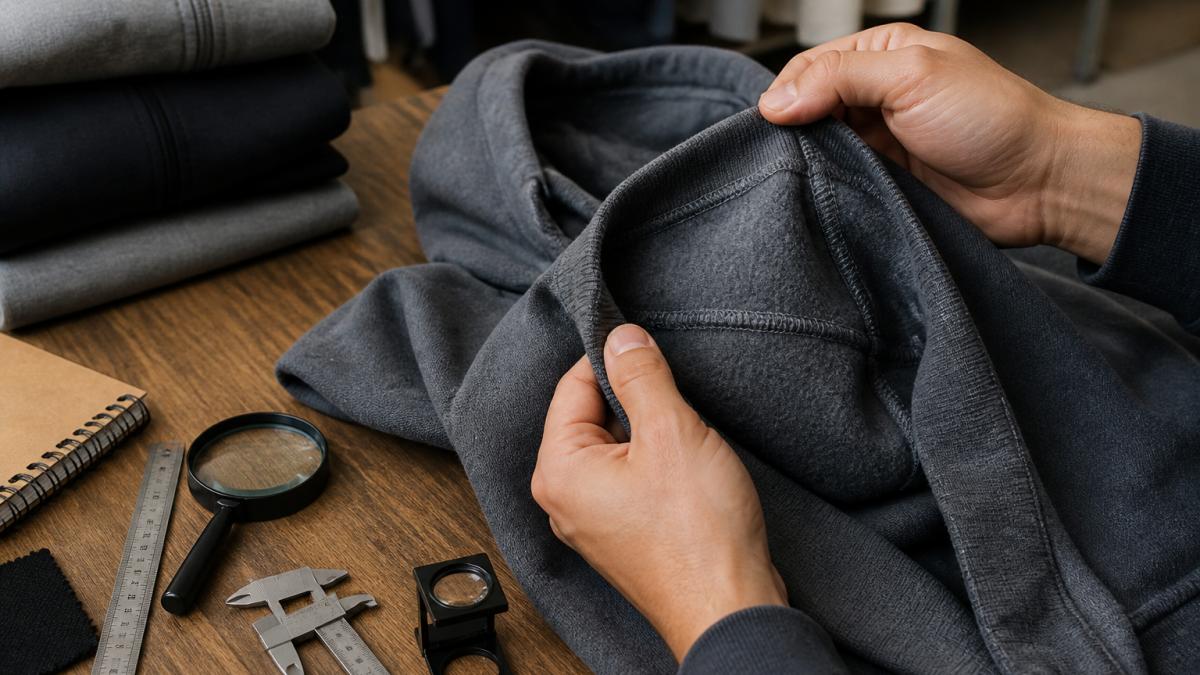
Check Fabric Weight and Hand Feel First
Heavy fabric is the fastest signal of quality. Pick up the garment and let it hang. A premium piece feels dense and substantial.
Fabric hand feel is how a material feels against your skin.
One warning: weight alone does not guarantee quality. A heavy garment with poor stitching will still fall apart. Use weight as your first filter, not your only one.
Examine Seams, Stitching, and Construction
Turn the garment inside out. This is where cheap clothing gives itself away.
Look for stitch density, meaning how many stitches fit into each inch of seam.
Check for reinforced seams at stress points. Shoulders, armholes, and the crotch of any pant take the most strain.
A few loose threads are normal; a trail hanging off every seam means nobody checked the garment before it shipped.
Inspect Finishing Details: Hems, Necklines, and Hardware
Finishing is where a brand either cares or does not. The hem should be straight, even, and double-stitched; a wavy hem only gets worse after washing.
The neckline is the number one failure point on hoodies and tees. Pull the collar gently: it should snap back into shape.
Then check the hardware: zippers, buttons, snaps, and eyelets. A quality zipper glides without catching; cheap ones stick and break.
Streetwear Fabric Quality: GSM, Fiber Content, and What Actually Matters
Streetwear fabric quality comes down to three things: GSM, fiber content, and finish. GSM (grams per square meter) measures fabric weight, fiber content tells you what it is made of, and finish tells you how it behaves after ten washes.
Most guides stop at a single GSM table, but a 300 GSM cotton jersey and a 300 GSM polyester fleece are not comparable. Use the benchmarks below by fabric type, not as one universal scale.
GSM Benchmarks by Streetwear Fabric
| Fabric | Lightweight | Mid-weight | Heavyweight | What Heavyweight Buys You |
|---|---|---|---|---|
| Cotton jersey (tees) | 120-150 GSM | 160-200 GSM | 210-260 GSM | Opacity, structure, slower collar deformation |
| French terry (hoodies, sweats) | 240-280 GSM | 300-380 GSM | 400-560 GSM | Warmth, drape, resistance to thinning at cuffs |
| Fleece-back (hoodies) | 280-320 GSM | 350-420 GSM | 450-550 GSM | Loft, warmth, shape retention in the body |
| Denim (jeans, jackets) | 8-10 oz | 11-13 oz | 14-16 oz+ | Fade character, structure, seam stress tolerance |
| Rib knit (cuffs, collars) | 180-220 GSM | 230-280 GSM | 300+ GSM | Recovery, resistance to going slack |
Notes on reading this table:
- Heavier is not automatically better. A 260 GSM tee can feel stiff and hot in summer, while a tightly knit 150 GSM tee can outlast a loose 200 GSM one.
- Denim is measured in ounces per square yard in most American listings. Convert roughly: 1 oz ≈ 34 GSM, so 12 oz denim is about 400 GSM.
- Rib knit weight matters. A 180 GSM rib collar stretches out long before the body fabric fails.
Fiber Content: What Each Fiber Actually Does
Fiber content is listed as a percentage on the care label. Here is what each fiber contributes:
- Cotton, breathes, takes dye well, softens with washing, but shrinks and wrinkles. Long-staple cottons (Pima, Supima, Egyptian) produce smoother, stronger yarns than standard upland cotton.
- Polyester, adds durability, colorfastness, and shape retention, but too much feels slick and traps odor. A 50/50 blend is common in budget fleece.
- Rayon and viscose, drape well and feel soft, but pill and lose shape faster than cotton. Often used to cut cost while keeping a soft hand feel.
A common pattern: a 100% cotton heavyweight tee feels rougher on day one than a 60/40 cotton-poly tee, but feels better by month six, while the poly tee stays smooth and starts to pill.
Finish and Construction Cues in the Fabric Itself
GSM and fiber content do not tell the whole story. Look for these finish signals:
- Combed vs. carded cotton. Combed cotton has short fibers removed, so it pills less and feels smoother; carded cotton is cheaper and rougher.
- Ring-spun vs. open-end yarn. Ring-spun is finer and stronger; open-end is faster to produce and coarser.
- Garment-dyed vs. piece-dyed. Garment-dyed has softer, more uneven color that fades with character; piece-dyed is more uniform but can look flat.
Watch for artificial shine. Real cotton has a matte finish; if a garment gleams under store lighting, it likely has high synthetic content or a chemical coating, and may pill after a few washes.
Premium Hoodie Quality: What Separates a $90 Hoodie From a $40 One
Premium hoodie quality shows up in four places: fabric weight, hood construction, cuff and waistband ribbing, and the neckline seam.
The biggest difference is the fabric.
What Broke Me Heavyweight Hoodie | Original | Slate | 16.5 oz →
Hood construction matters more than people realize: a double-layer hood keeps its shape, while a single-layer hood collapses within weeks.
Cuffs and waistbands are the second failure point.
Then there is the neckline: single-needle topstitching keeps the collar from twisting, a small detail most brands skip.
Your Repeatable In-Store and Online Inspection Checklist
Use the same checklist whether you are holding the garment or looking at it on a screen. The goal does not change: find the weak points before you pay.
In-Store: What to Touch, Stretch, and Hold Up to Light
- Pick up the garment and judge the weight in your hand
- Stretch each seam gently and look for gaps
- Turn it inside out and check stitch consistency
Online: How to Judge Quality From Product Photos and Specs
- Look for GSM or fabric weight in the specs
- Confirm fiber content is listed as a percentage
- Zoom into photos for visible stitching detail
If an online listing shows none of these, that is your answer. A brand confident in its construction shows it.
How Quality Varies by Garment Category: Tees, Hoodies, and Headwear
Quality standards shift by category. A great tee and a great hoodie are built differently, and judging them by the same rules leads to bad calls. Here is what to check for each.
Tees
Tees live or die by fabric weight and collar construction.
- Fabric weight. A premium tee runs 210 GSM (about 6.2 oz) or heavier. Tees under 150 GSM rarely survive a year of regular wear.
- Collar. Look for a ribbed collar with a separate binding strip, not a self-fabric collar folded over, those twist and stretch out first.
- Shoulder seams. Taped shoulder seams prevent stretching; untaped seams on a heavyweight tee pull within months.
Hoodies and Sweatshirts
Hoodies depend on fabric weight, hood structure, and ribbing.
- Fabric weight. Anything under 400 GSM feels thin next to a true heavyweight; 450-560 GSM is where premium hoodies sit.
- Hood. Double-layer hoods hold shape; single-layer hoods collapse. Look for a hood that stands up on its own when laid flat.
- Ribbing. 2x1 rib at cuffs and waistband recovers; 1x1 rib goes slack. Check by stretching and holding for three seconds.
Denim
Denim is judged differently from knits.
- Weight. 12-14 oz is the sweet spot for daily wear. Under 10 oz feels flimsy; over 16 oz is stiff and slow to break in.
- Selvedge vs. non-selvedge. Selvedge is woven on shuttle looms with a finished edge. Not automatically better, but it usually signals tighter quality control.
- Stitching. Look for chain-stitched hems (which produce a roping fade) and reinforced bar tacks at pocket corners and belt loops.
Outerwear
Outerwear quality shows up in the shell, the lining, and the closures.
- Shell. Look for a tight weave that blocks wind. Hold it up to light; if you can see through it, it will not block much.
- Lining. A full lining is easier to slip on and protects the shell; unlined jackets wear faster at the shoulders.
- Zippers. A two-way zipper is a quality signal, as is a zipper guard (a flap of fabric behind the zipper) to prevent snagging.
Headwear
Headwear is different. Fabric weight matters less than structure and print durability.
- Front panel. A structured front panel (often with buckram or firm interfacing) keeps its shape; unstructured panels collapse.
- Closure. A metal snapback or quality plastic snap holds firmly; Velcro and cheap plastic snaps wear out fast.
- Sweatband. A cotton twill sweatband absorbs and wicks; a cheap polyester band traps heat.
Accessories
Accessories are small, so construction flaws are easier to hide.
- Bags. Check the zipper (YKK or equivalent), the strap attachment (bar-tacked, not just stitched), and the lining (a separate lining outlasts a raw interior).
- Socks. Look for a reinforced heel and toe, a ribbed cuff, and a cotton-rich blend (at least 70% cotton).
- Belts. Full-grain leather outlasts bonded leather; the buckle should be solid metal, not plated plastic.
Our Structured Mesh Snapback Hat uses a structured front panel, breathable mesh back, and a durable DTF graphic built to resist cracking. That is the headwear version of the same principle: structure first, decoration second.
Why Premium Streetwear Brands for Men Cost More (And When It's Worth It)
Premium streetwear brands for men charge more because the materials cost more. Heavyweight French terry, dense stitching, and double-layer construction all add cost at every step.
But price alone is not proof of quality. Plenty of expensive brands sell thin fabric with a big logo.
How to decide:
- Cost per wear beats sticker price. A hoodie worn twice a week for three years costs far less per wear than a cheap one replaced every season.
- Check the specs, not the marketing. Fabric weight, fiber content, and construction details tell the real story.
- Consider longevity. A garment that keeps its shape after 50 washes is worth more than one that looks tired after 10.
EVRMORE hoodies are cut and sewn in Los Angeles, and we list fabric weight, fiber content, and construction details on every product page.

Conclusion: Build a Wardrobe That Outlasts the Hype
Hype fades. Construction does not. Once you know how to identify premium streetwear quality, you stop paying for logos and start paying for fabric, seams, and finishing that hold up.
That is the point of what we make. Our heavyweight tees, hoodies, and headwear use dense fabric, reinforced construction, and graphics built to last.

Add to cart and build a wardrobe that lasts as long as you have.
Frequently Asked Questions
How can you tell if streetwear is high quality?
Check three things before anything else: fabric weight, seam construction, and finishing details. A premium hoodie should feel dense in your hands, with fabric weight around 16 oz or higher for cold-weather pieces. Look at the seams. Single-needle topstitching at the neckline and reinforced stress points signal real construction. Finally, inspect the hem, cuffs, and collar for even ribbing and no loose threads. If any of these fall short, the piece is likely riding on branding rather than build quality.
Does heavyweight fabric mean better-quality streetwear?
Heavier fabric usually signals better durability, but weight alone does not guarantee quality. A 16.5 oz French terry hoodie with tight, consistent stitching will outlast a heavier garment with sloppy seams every time. Pay attention to fiber content too. An 80% cotton / 20% polyester blend holds shape well and resists pilling. Check how the fabric drapes and whether it has an artificial shine, which often points to lower-grade materials. Weight matters, but construction and fiber content matter just as much.
What details indicate that a hoodie is well made?
Start with the hood itself. A double-layer hood holds its shape after washing, while a single-layer one collapses. Check for single-needle topstitching at the neckline, which prevents stretching. Look at the cuffs and waistband: 2x1 ribbing provides better recovery than cheaper alternatives. Reinforced seams at the shoulders and armholes matter because those are the highest-stress areas. Also check the care label for pre-shrunk fabric, which reduces shrinkage after the first wash. These details separate premium hoodie quality from fast-fashion imitations.
How should you compare streetwear brands for durability?
Compare specific construction specs rather than marketing claims. Look for stitch density (more stitches per inch means stronger seams), reinforced stress points, and pre-shrunk fabric. Check whether the brand lists fabric weight in GSM or ounces. For example, a 560 GSM French terry hoodie is substantially heavier than a standard mid-weight option at 300-400 GSM. Read customer reviews that mention wash performance and pilling after multiple cycles. Brands that publish these details openly tend to stand behind their products.




Leave a comment
This site is protected by hCaptcha and the hCaptcha Privacy Policy and Terms of Service apply.